
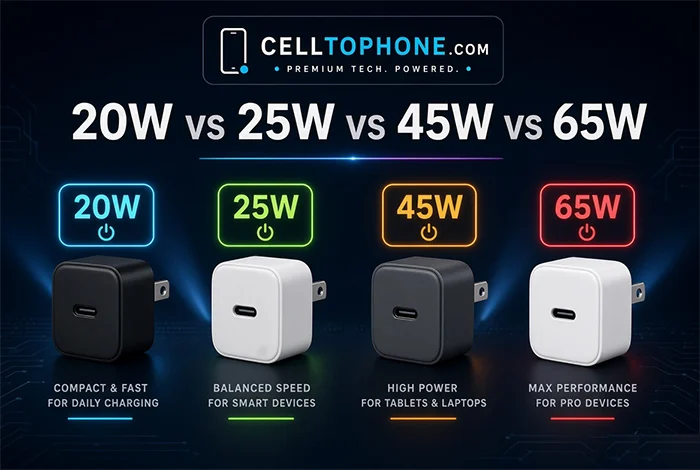
Walk into a mobile shop and ask for a fast charger, and you will probably hear a few numbers before you hear anything else: 20W vs 25W vs 45W vs 65W charger.
Online, the choice gets even bigger. Some chargers are advertised at 33W, 67W, 100W or more. Then come the technical terms — USB-C, PD, PPS, GaN — which make the buying decision look harder than it really is.
A common assumption is that a 65W charger must be better than a 25W charger. It sounds logical, but there is a catch.
Your phone decides how much power it can actually use.
So, buying a 65W adapter for a phone designed to charge at a much lower rate may not make charging dramatically faster. On the other hand, if you use a phone, tablet and USB-C laptop, a 20W charger can quickly become inconvenient.
That is why the right charger depends less on the biggest number on the box and more on what you are charging every day.
20W vs 25W vs 45W vs 65W charger
| Charger | Good choice for | What makes it useful |
|---|---|---|
| 20W | Basic smartphone charging | Small and easy to carry |
| 25W | Compatible Android phones | Good everyday balance |
| 45W | Phones, tablets and some other USB-C devices | More charging headroom |
| 65W | Phones, tablets and compatible laptops | One charger for several devices |
There is no universal winner here.
A 20W charger can be the right purchase for one person, while 65W may be the obvious choice for somebody else.
What Does the Wattage on a Charger Mean?
The wattage tells you the maximum power a charger can provide under the conditions supported by the charger and connected device.
So, in simple terms:
- A 20W charger can provide up to 20W.
- A 25W charger can provide up to 25W.
- A 45W charger can provide up to 45W.
- A 65W charger can provide up to 65W.
But the connected device does not simply take the maximum number printed on the charger.
With USB Power Delivery, compatible devices and chargers communicate and negotiate an appropriate power level. USB-IF describes USB PD as a flexible power-delivery system designed to work across a wide range of devices.
That is why connecting a 25W phone to a 65W charger does not automatically mean the phone will charge at 65W.
The charger may be capable of 65W.
The phone may not be.
That difference is important when comparing chargers.
20W Charger: Still a Good Option for Many Phones
There is nothing wrong with choosing a 20W charger in 2026.
If your main device is a smartphone and you do not need to charge a laptop or other high-power USB-C equipment, 20W can be perfectly adequate.
It is also convenient for travel. A smaller charger takes up less room in a bag, which matters when you already carry a phone, power bank, earphones and other accessories.
A 20W charger can make sense for:
- Everyday smartphone charging
- Bedside use
- Office desks
- Travel
- Compatible iPhones
- Phones designed for around 20W charging
Suppose you leave your phone charging overnight and occasionally top it up during the afternoon. You may never notice a meaningful advantage from carrying a 65W charger.
In that situation, paying extra for unused power doesn’t necessarily make sense.
The better approach is to check your phone’s charging specification first.
25W Charger: The Comfortable Middle Ground
25W is a popular charging level, especially among Android smartphones.
For somebody who wants a compact charger but does not want to stay at the lower end of the market, it can be a sensible middle option.
Samsung’s charging ecosystem is a good example of why wattage alone doesn’t tell the whole story. Compatible Samsung chargers can use USB Power Delivery and PPS, and the actual charging capability varies between Galaxy devices.
So if your phone supports 25W charging, a properly matched 25W charger can be all you need.
It is particularly suitable for people who:
- Mainly charge one smartphone
- Want a compact adapter
- Work from home or an office
- Travel regularly
- Want to replace an older 10W or 15W charger
There is also a practical reason not to jump straight to a 45W or 65W adapter.
Higher wattage costs money, takes up space and only becomes useful when your device can take advantage of it.
If your phone is happy with 25W, a good 25W charger is not a compromise.
45W Charger: Where Things Get More Interesting
A 45W charger gives you considerably more flexibility.
It can be useful for compatible smartphones, tablets and other USB-C devices. For people who have moved beyond phone-only charging, that extra capacity can be convenient.
Take a simple example.
You have a fast-charging smartphone and a USB-C tablet. Instead of keeping two different chargers in your travel bag, you can use one suitable 45W adapter for both.
Samsung’s 45W power adapter, for example, supports USB PD 3.0 with PDO and PPS and can deliver up to 45W under supported conditions. Samsung also notes that charging performance can vary depending on the device, cable, usage and environment.
That makes 45W a useful middle ground.
You get more flexibility without necessarily moving to the size and cost associated with some higher-power laptop chargers.
Who should consider 45W?
Someone who:
- Has a phone supporting faster charging
- Uses a USB-C tablet
- Wants one charger for several devices
- Travels frequently
- Wants more power than a standard phone charger
For many users, 45W is the point where a charger starts feeling genuinely versatile.
65W Charger: Best for a Multi-Device Setup
A 65W charger is much easier to justify when you own several devices.
Imagine your everyday setup includes a smartphone, tablet and USB-C laptop.
Carrying separate adapters for all three can be annoying.
A suitable 65W charger can potentially handle the job with one adapter.
This is one reason 65W GaN chargers have become popular with travellers and people who work from different locations.
There is another detail to watch, though.
A 65W multi-port charger does not mean every port delivers 65W.
For example, a multi-port charger may provide its full rated output through one USB-C port, while using two or three ports causes the available power to be divided between devices.
Samsung’s 65W multi-port adapter specifications demonstrate this type of power distribution, with different outputs depending on the ports and devices being used.
So if you are buying a 65W charger mainly because you want to charge several devices together, check the port-by-port output, not just the large “65W” figure on the packaging.
20W vs 25W: Is the Difference Worth Paying For?
The answer depends on your phone.
If your smartphone supports only around 20W, moving to a 25W charger may not make a dramatic difference.
But if your phone supports 25W charging and you are buying a new adapter anyway, choosing a compatible 25W charger makes sense.
There is no reason to upgrade simply because 25W looks more impressive.
A charger should solve a problem.
If your current 20W charger charges your phone comfortably and is still in good condition, you don’t necessarily need a replacement.
25W vs 45W: Which Is More Practical?
This is a more interesting comparison.
For phone-only users, 25W is often enough.
For people with a phone plus tablet or another USB-C device, 45W starts making more sense.
For example, if you are charging your phone during a short lunch break, the higher output can be useful only if your phone is designed to accept it.
If it isn’t, the extra 20W sitting inside the charger does nothing for that phone.
So the decision comes down to your devices rather than the charger itself.
25W is practical. 45W is more versatile.
45W vs 65W: Which Charger Should You Buy?
This is probably the decision most people should think about before buying a higher-power charger.
Choose 45W if your setup is mainly:
Phone + tablet + accessories
Choose 65W if your setup includes:
Phone + tablet + laptop
That extra power becomes much more useful when a laptop enters the picture.
Of course, laptop requirements vary. Some USB-C laptops can operate with lower-power adapters, while others recommend 65W or more.
Always check the laptop manufacturer’s charging requirement.
Don’t assume every USB-C laptop needs exactly 65W.
Will a 65W Charger Make a 25W Phone Charge Faster?
Not necessarily.
This is probably the most common misunderstanding about fast chargers.
Suppose your phone is designed to accept a maximum charging power around 25W.
You connect it to a 65W charger.
The charger has the ability to provide more power, but the phone still controls how much it accepts.
The same problem happens in reverse.
If your phone supports a higher charging mode but your charger doesn’t support the required protocol, you may not get the fastest charging available from the phone.
So a properly compatible 25W charger can be a better match than a generic 65W charger.
The wattage number is only one part of the specification.
USB-C PD: Why It Matters
USB-C is the connector.
USB Power Delivery, commonly called USB PD, is a power-delivery standard used through USB-C.
That distinction matters because two USB-C chargers can have very different capabilities.
USB PD allows compatible devices and chargers to negotiate power instead of simply sending the maximum amount available. USB-IF’s documentation covers USB PD as a scalable charging system used across devices ranging from smaller electronics to higher-power equipment.
USB PD 3.1 also expanded supported power levels up to 240W with suitable equipment.
That does not mean you need a 240W charger for a phone.
It simply shows why USB-C has become the common charging connection for so many different types of electronics.
When shopping for a modern charger, USB PD support is worth checking, especially if you charge tablets or laptops.
What Is PPS on a Charger?
PPS stands for Programmable Power Supply.
It is often found on modern USB-C fast chargers, particularly those aimed at compatible Android devices.
Rather than relying only on fixed voltage steps, PPS allows compatible devices and chargers to adjust voltage and current during charging.
Samsung explains that PPS can adjust voltage and current according to the charging status of a compatible device.
This is why a charger with the right PPS support can sometimes be a better choice than a charger with a higher wattage but the wrong charging protocol.
If your phone specifically requires PPS for its fastest charging mode, look for PPS in the charger’s specifications.
The Cable Matters More Than People Think
A fast charger is only one part of the setup.
The USB-C cable also needs to be suitable for the power you are trying to deliver.
This becomes increasingly important at 45W and 65W.
USB-IF provides power capability markings for certified USB-C to USB-C cables, including 60W and 240W cable markings.
Samsung also recommends suitable 5A cables for certain high-power charging modes.
So buying a 65W charger and pairing it with an unsuitable cable can leave you wondering why the phone or laptop isn’t charging as expected.
Think of it as a complete setup:
Device → Charger → Cable
All three have to support the charging mode you want.
Why Does Fast Charging Slow Down Sometimes?
Seeing slower charging does not automatically mean that your charger is bad.
Phones can change charging behaviour for several reasons.
The battery may already be at a relatively high level. The phone may be warm. The charger may not support the required charging protocol. The cable may also be limiting the available power.
Samsung notes that charging performance can be affected by factors including the device, cable, usage and surrounding environment.
Multi-port chargers can behave differently too.
If you connect a phone and laptop to the same 65W charger, the available power may be divided between them.
This is normal behaviour for many multi-device chargers.
Does a Higher-Watt Charger Damage Your Phone?
A higher-rated charger does not automatically push its maximum wattage into every connected phone.
With a properly designed compatible charger, the connected device requests or accepts an appropriate level of power.
That said, this is not a reason to buy the cheapest charger you can find.
A charger is an electrical device that you use regularly and often leave connected for long periods. Build quality, protection features, certification and the reputation of the manufacturer matter.
If a charger looks suspiciously cheap compared with similar products, saving a few hundred rupees may not be worth the risk.
What About GaN Chargers?
GaN stands for Gallium Nitride.
You will usually see GaN mentioned on compact, higher-power chargers.
The main attraction is size.
If you need a 65W charger for a laptop and phone, a compact GaN adapter can be much easier to carry than several older-style chargers.
For frequent travellers, this can be a genuine advantage.
But GaN is not something every phone owner needs.
If you only want a 20W charger for your bedside table, buying a GaN model may not provide much practical benefit.
It is more useful when you need higher power without carrying a large adapter.
Which Charger Is Best for iPhone Users?
The answer depends on the particular iPhone and the rest of your devices.
If you mainly charge an iPhone, a compact USB-C charger around the 20W class may be sufficient for many users.
If you also have an iPad, MacBook or another USB-C device, a 45W or 65W charger can be more convenient.
The important thing is not to assume that buying a 65W adapter automatically means your iPhone will charge at 65W.
The phone’s own charging capabilities still apply.
Which Charger Is Best for Samsung and Android Users?
Android charging varies considerably between manufacturers and models.
Some phones are comfortable with 20W or 25W. Others support 45W or higher charging.
Samsung’s own accessories show why checking compatibility matters: its 25W and 45W charging products have different specifications, while higher-output multi-port chargers are designed to handle several devices.
So don’t buy a 45W or 65W charger just because you have an Android phone.
Check the exact model.
The same rule applies to Xiaomi, OnePlus, Motorola, Vivo, OPPO, Realme and other brands. Proprietary fast-charging systems can have requirements that differ from standard USB PD charging.
Which Charger Should You Buy in 2026?
If you want a straightforward answer:
20W is a good choice for simple phone charging.
25W is a sensible everyday option for compatible smartphones.
45W is more useful when you also charge tablets or other USB-C devices.
65W is the better choice when you want one charger that can handle a phone, tablet and compatible laptop.
There is no reason to buy 65W just because it is the largest number in the shop.
If your phone needs 20W, buy a good 20W charger.
If your laptop needs 65W, then 65W makes sense.
The device should decide the charger — not the other way around.
A Quick Buying Checklist
Before buying a fast charger, spend a minute checking these things:
Check the phone’s maximum charging speed.
This tells you how much power the phone can actually use.
Check USB PD support.
This matters for many modern USB-C devices.
Check PPS if your phone requires it.
Especially relevant for certain fast-charging Android phones.
Check the cable.
A high-power charger needs a cable suitable for the intended charging level.
Check the number of ports.
One port is simple; multiple ports are useful if you carry several devices.
Check power sharing.
A 65W multi-port charger may divide its output when several devices are connected.
Check the manufacturer and safety features.
Don’t choose a charger purely because it is the cheapest listing.
For Mobile Shops and Wholesale Buyers
For retailers, wholesalers and resellers, charger wattage is also a stocking decision.
Keeping only one charger type can limit your customer base.
A mobile shop may have customers looking for a basic 20W or 25W phone charger, while another customer may specifically want a 45W or 65W USB-C charger for a newer smartphone, tablet or laptop.
A practical stock mix can therefore be more useful than putting all your money into one wattage.
When buying chargers in bulk, look beyond the printed wattage. Port type, charging protocol, cable compatibility, build quality and device compatibility can all affect whether a product is easy to sell.
For a wholesale business like CellToPhone, this is especially relevant because retailers often need products covering different price points rather than one universal charger.
Final Verdict: 20W, 25W, 45W or 65W?
The simplest answer is:
Buy 20W if you want a basic compact phone charger.
Choose 25W if your compatible phone supports it and you want a practical everyday option.
Go for 45W if you want something more versatile for phones and tablets.
Choose 65W if you’re charging several USB-C devices, especially a laptop.
And remember the part that gets lost in charger advertisements:
A higher wattage does not automatically mean faster charging.
Your phone, charger and cable need to work together.
Once you check those three things, choosing between 20W, 25W, 45W and 65W becomes much less complicated.
Frequently Asked Questions
Is a 65W charger better than a 25W charger?
Not for every phone. A 65W charger can provide more power, but the phone determines how much power it can accept.
Can I use a 65W charger with a 25W phone?
A reputable compatible charger can generally be used with a lower-power device. The phone will operate within its supported charging limits.
Will a 65W charger make my phone charge at 65W?
No. The phone must support that charging level and the charger must provide the required charging protocol.
Is 20W enough for a phone?
For many compatible smartphones, yes. If your phone is designed around 20W charging, there may be little reason to buy a much higher-output charger.
Is 25W enough in 2026?
Yes, for phones that support 25W charging. A newer, higher-wattage charger isn’t automatically necessary.
Is 45W better than 25W?
Only when your device can use the additional power. For a 25W phone, a 45W charger will not necessarily provide faster charging.
Is 65W enough for a laptop?
It can be, depending on the laptop. Check the manufacturer’s recommended charger wattage before buying.
Does the USB-C cable affect charging speed?
Yes. The cable’s power capability can affect a high-power charging setup.
What is USB PD?
USB Power Delivery is a power-delivery standard used over USB-C. It allows compatible devices and chargers to negotiate suitable power levels.
What is PPS?
PPS means Programmable Power Supply. It allows compatible chargers and devices to adjust voltage and current more dynamically during charging.
Are GaN chargers worth buying?
They can be worthwhile if you want a compact high-power charger for travel or several devices. They are not necessary for basic phone charging.
Can I charge my phone and laptop with one 65W charger?
If both devices support the charger’s output and charging standards, yes. With multi-port chargers, remember that the available power may be divided between connected devices.